Emotional Freedom
Emotional freedom doesn't mean that life becomes free from pain...
The journey is not about changing who you are. It is about coming home to who you are.
You don't need to fix everything that is "wrong" with you.
You don't need to become someone else.
You don't need to eliminate every difficult emotion.
The journey is about becoming aware of what is already within you,
meeting it with courage and compassion,
releasing what no longer serves you —
and creating the freedom to choose how you want to live.
At the centre of it all is love.
Learning to accept yourself.
Learning to trust yourself.
Learning to give and receive love.
Learning to live from your heart rather than from fear.
From the inside out
When we begin to see ourselves more clearly — with awareness, presence and the courage to take responsibility — something begins to shift.
Not necessarily the world around us.
But the way we choose to meet it. And slowly, we begin to find the freedom to…
Live from love rather than fear.
Be ourselves without constantly seeking approval.
Feel our emotions without being ruled by them.
Let go of old stories about who we are.
Stop trying to control everything around us.
Make conscious choices that reflect who we truly are.
Give and receive love more freely.
Trust ourselves enough to live the life we want to live.
Because emotional freedom isn't about becoming someone else.
It's about freeing yourself to be who you truly are.
Strong and free — from the inside out.
When you change your perspective you will meet life from a place of freedom.
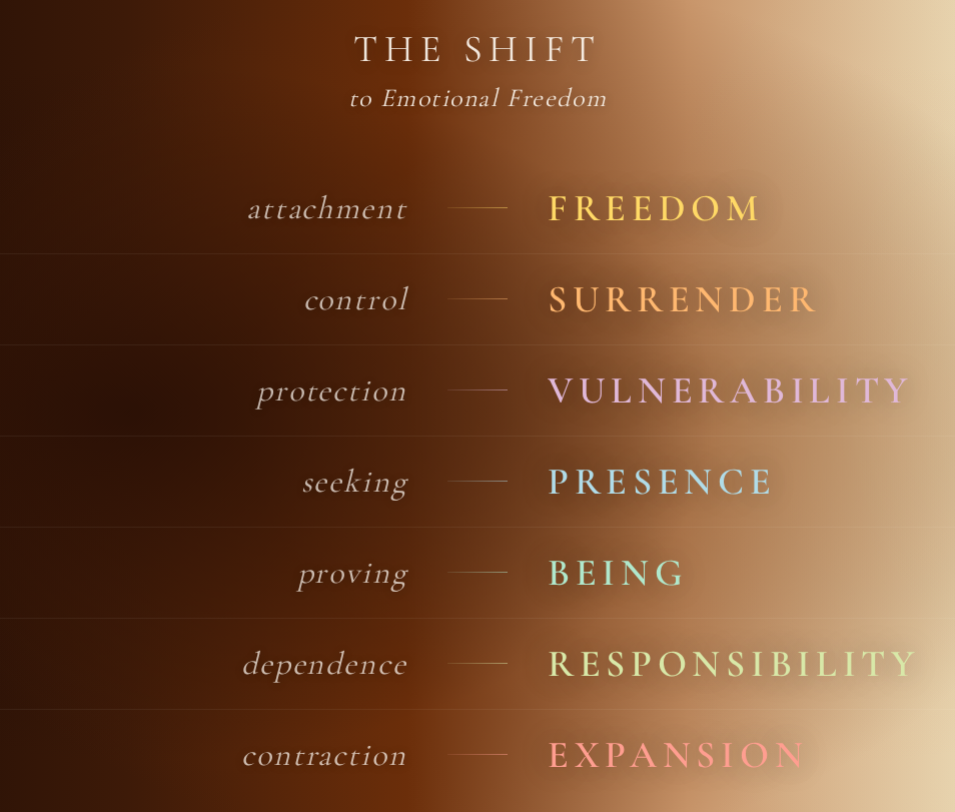
Feel Without Fear
Your emotions are not your enemy.
To have feelings and emotions is all part of being human.
I believe emotions need to be experienced, not feared.
They can be intense. They can be uncomfortable. Sometimes they can feel overwhelming.
But an emotion is not an instruction.
You can feel anger without acting from anger.
You can feel fear without allowing fear to make every decision.
You can feel sadness without becoming your sadness.
Through awareness and presence, we learn to create space between what we feel and how we respond.
That space creates choice.
And when we stop fearing what we feel, our emotions become something else entirely —
information, guidance, an invitation to look deeper into what is really asking for our attention.
The Stories We Live From
We all carry beliefs about ourselves and the world.
I'm not good enough. I have to achieve to be worthy. I must keep everyone happy. If I let go, everything will fall apart.
Some of these beliefs were formed very early in life.
Some may have once protected you.
But a belief is not necessarily a fact simply because we've carried it for a long time.
So we become curious: Is this true? What else could be true?
Who would I be without this belief?
Responsibility Without Blame
Taking responsibility is not the same as taking the blame.
You cannot control what another person does.
You cannot control what has happened in the past.
But you can become responsible for how you meet what happens.
Your thoughts.
Your choices.
Your boundaries.
Your response.
Your life.
Responsibility is not about blaming yourself.
It is about reclaiming your power.
